
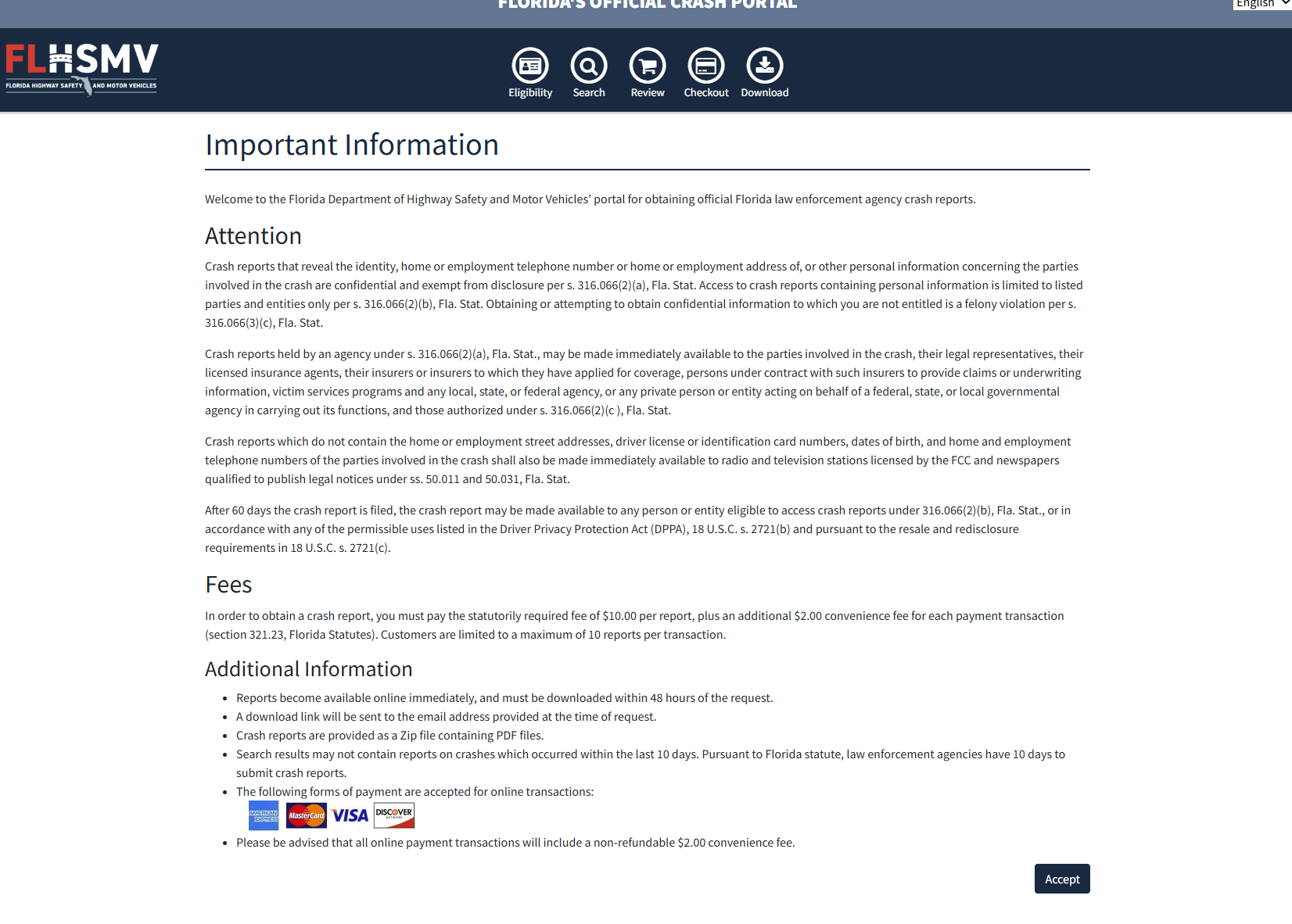
You buy it. Florida crash reports are sold through FLHSMV’s official Crash Portal for $10 per report plus a $2 transaction fee, and you can search by your name, the date, and the county. Agencies have up to 10 days to file the report, so if your wreck was last week it may not be there yet.
That is the whole procedure, and it is genuinely simple. The part worth your attention is what the report is actually for, because most people treat it as a receipt for the accident and file it away. It is not a receipt. It is the first page of the investigation into who has to pay you.
What is a crash report?
It is the Florida Traffic Crash Report, written by the officer who responded to your wreck under section 316.066, Florida Statutes. On a handful of pages it captures things that exist nowhere else once the road is cleared:
- Every driver, and separately, the registered owner of each vehicle, who is frequently not the same person.
- The insurance company and policy number the officer collected from each driver.
- A diagram of the vehicles, the roadway, and the point of impact.
- The officer’s narrative of how the crash happened.
- Witness names and phone numbers.
- Any citation issued, and injuries noted at the scene.
Thirty minutes of an officer’s time produces a document you could not reconstruct later for any amount of money.
Why does it matter that I call the police?
Because if nobody calls, none of the above exists.
The other driver, standing on the shoulder with a dented bumper, is often very persuasive about handling it privately. Sometimes they are being decent. Sometimes they know something about their license or their coverage that you do not. Either way, the version of events you agreed to at the roadside evaporates the moment their insurer asks them what happened.
Florida law requires law enforcement notification for a crash involving injury, a fatality, a hit and run, a DUI, a commercial vehicle, a vehicle that has to be towed, or apparent damage of at least $500. In practice, if you are hurt at all, call. I go through this in more detail in what to do right after a wreck in Florida.
Then photograph both vehicles’ damage before anything moves. Not just yours. Theirs. The report gives you the officer’s diagram; your photos give you the physics. When an adjuster later suggests the impact was too minor to hurt anyone, photographs of the actual crush are the answer. Get the wider scene too: skid marks, debris, signals, where the cars ended up.
That matters more than it sounds, because of a limitation that surprises people. In Florida, the crash report itself generally does not come into evidence at a civil trial, and statements you made to the investigating officer are protected as well. The report is an investigative tool, not a trial exhibit. Your photographs are evidence. That is why they are worth the ninety seconds.
What is the crash report actually good for?
Coverage. That is the answer, and it is where the report earns its $10 several hundred times over.
Look at the insurance block, then look at the owner field. When the driver who hit you was not the owner of the car, there are frequently two policies in play, not one. Florida treats a car as a dangerous instrumentality, which means an owner who hands the keys to someone else can be responsible for what that person does with it. The driver has a policy. The owner has a policy. Both can be reachable.
This is one of the most reliable ways I find money for clients. Somebody borrows a girlfriend’s car, drives a vehicle titled to a parent, takes a company truck home for the weekend, and the crash report has both names sitting right there in separate fields. I regularly find additional policies this way, and clients who came in convinced there was only minimum coverage available turn out to have considerably more.
How often is a rough estimate rather than a tally, but I would put it somewhere between 20 and 40 percent of my cases. That is frequent enough that the owner field is one of the first things I read.
The insurance block is not the only part worth your time, either. The officer’s narrative tells me what they believed happened and why, which shapes the questions I ask next. A citation issued to the other driver changes the tone of every conversation with their adjuster. And the witness names and numbers are often the only ones anybody will ever have, because those people drove away and there is no second chance to collect them.
So is the report all I need?
No, and I want to be straight about this rather than sell you the easy version.
The crash report tells you what a driver handed an officer at the roadside, and that snapshot is wrong more often than you would think. Cards are expired. Policies were cancelled for nonpayment two months earlier. The card is real but the limits are the state minimum. And the report shows only what was at the scene. It cannot show you:
- Whether the driver was working at the time, which can open a commercial policy far larger than anything on the card.
- Your own uninsured and underinsured motorist coverage, which lives on your policy and often on a household member’s.
- Umbrella coverage sitting above the auto policy.
- What the actual policy limits are, which an insurer has to disclose in response to a proper written request, and which the report never states.
Running that down means writing to insurers, reading the actual policy language rather than the summary, and knowing which questions produce answers. It is the same work that decides how long your case takes and when it should settle, and it is the reason a hit and run is often far less hopeless than it feels. It is also why the statute lets your attorney pull the report during the confidential 60-day window: the people who need it early are you, your insurer, and your lawyer.
Pull the report yourself. It is $10 and it is yours. Just do not mistake it for the answer.
Where do I get it if the portal does not have it?
Around here, the agency that worked your crash is usually Bay County Sheriff’s Office, Panama City Beach Police, or Panama City Police, with Florida Highway Patrol on Highway 98 and the bridges, Walton County Sheriff’s Office east toward Destin, and Okaloosa County Sheriff’s Office past that. If the state portal comes up empty because you are inside the 10-day filing window, the responding agency’s records division may already have it.
FLHSMV also fulfills requests in person at the FHP troop station nearest the crash, and by mail, though mail runs four to six weeks. The other options are on FLHSMV’s traffic crash reports page, but for almost everyone the online portal is the right door.
Key takeaways
- The Crash Portal is the answer: $10 per report plus a $2 transaction fee, purchased online, downloaded within 48 hours.
- Wait up to 10 days. Agencies have that long to file, so a fresh crash may not appear yet. The responding agency may have it sooner.
- Call law enforcement, and photograph both vehicles’ damage. The report captures what disappears when the road clears; your photos capture what the report cannot.
- Read the owner field, not just the driver field. A borrowed or company car often means a second policy, which I would estimate happens in 20 to 40 percent of my cases.
- The narrative, the citation, and the witness list matter too, not just the insurance block. They shape what questions get asked next.
- The report is a starting point. It shows what was at the scene, not what actually covers your loss.
If you have your report in hand and you are looking at an insurance company you have never heard of, wondering whether that is all there is, that is worth a phone call. Finding the coverage nobody else looked for is a large part of what I do. Reach me, Phillip Stamman, at my Panama City Beach office: call (850) 842-5449 or contact me here for a free consultation. There is no charge to have me look, and you can read more about how I handle car accident cases in Panama City Beach.
This post is general information about Florida law, not legal advice, and reading it does not create an attorney-client relationship. Fees, procedures, and coverage questions vary with the facts and with your specific policy. Every case is different; talk to a lawyer about yours.
Stay safe out there,
Phillip Stamman
Solo Personal Injury Lawyer
Panama City Beach, Florida