
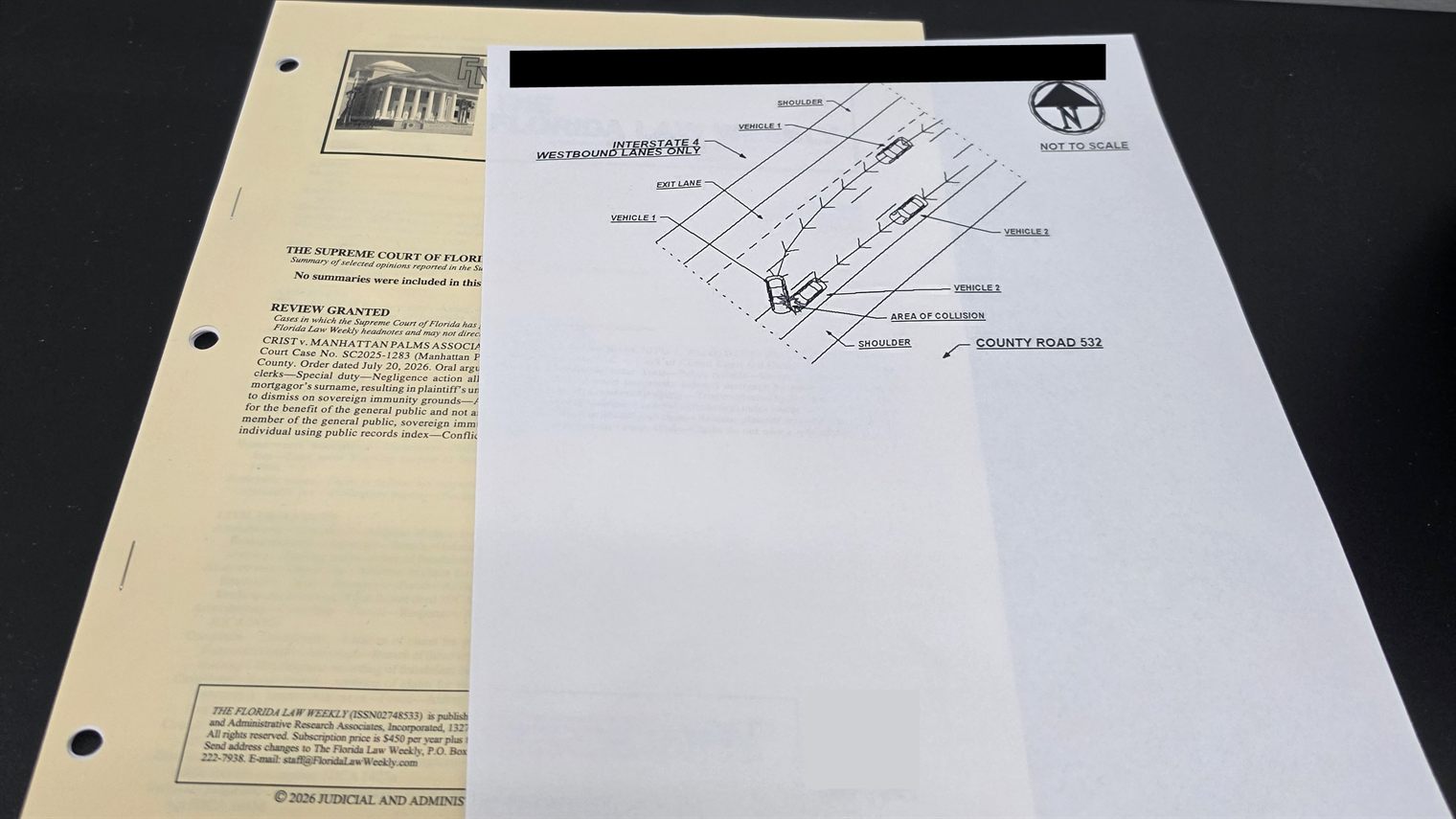
If the driver who hit you took off, do two things before you do anything else: call 911 so a law enforcement report gets written, and get yourself checked out. Then, before you conclude that nobody is going to pay for any of this, talk to a lawyer about what coverage might apply, because in my experience the answer is more often “yes” than people expect.
A hit and run feels like the end of the claim. Usually it is not. Your own Personal Injury Protection benefits pay regardless of who was at fault, and uninsured motorist coverage exists precisely for the driver who cannot be found. The trick is that the coverage is not always where you would think to look for it.
What do I do right after a hit and run in Florida?
Do not chase them. Chasing a fleeing driver gets people killed, and the plate number you might catch is not worth it.
Instead, in whatever order you are physically able:
- Call 911. I keep this simple with clients: call 911 and let dispatch figure out who responds. Whether it ends up being Panama City Beach police, the Sheriff’s Office, or the Highway Patrol is not your problem to sort out on the side of the road.
- Write down everything you remember about the vehicle while it is fresh. Color, body style, any part of the plate, damage, stickers, direction of travel. A partial plate plus a make and color is genuinely useful to law enforcement. Five minutes later you will remember less than you think.
- Get names and numbers from anyone who stopped. In a hit and run, an independent witness is worth more than in any other kind of crash, because there is no other driver to contradict.
- Photograph your vehicle before it is repaired or towed, including any paint transfer from the other car. That transferred paint is physical evidence that a second vehicle existed.
- Look around for cameras. Convenience stores, hotels, restaurants, and plenty of homes have them, and most systems overwrite themselves within days or weeks. This is one of the few things that genuinely cannot wait.
- Get medical attention. The clock on that starts now, not when you find out who hit you.
Why does reporting a hit and run to the police matter so much?
Because the police report is what makes your own claim believable.
Florida Statutes section 316.065 requires a driver to report a crash immediately when there is an injury or apparent property damage of at least $500, and that duty does not disappear because the other car left. But the reason I push people hardest on the report is not the statute. It is your own insurance company.
Think about the claim from their side. You are telling them a car hit you and drove away, and you are asking them to pay under coverage that only applies if that is true. A report taken at the scene, that night, with an officer writing down what you said before you had any reason to shape it, is powerful. A claim first reported four days later, after you talked to a friend who mentioned you might have coverage, invites a very different conversation. Many policies also require prompt reporting to law enforcement as a condition of paying a hit and run claim, and some set a specific deadline.
None of that means a late report kills your case. It means an immediate one protects it.
Does PIP still pay if the other driver ran?
Yes. This is the part that reassures people most, and almost nobody knows it going in.
PIP is no-fault coverage on your own policy. Under Florida Statutes section 627.736, it pays 80 percent of reasonable and medically necessary expenses up to your limit no matter who caused the crash, which means it pays exactly the same whether the other driver is identified, arrested, or never found at all.
What does not change is the deadline. Your initial treatment still has to happen within 14 days of the crash, and that window runs from the date of the wreck, not from the date the investigation goes anywhere. I have watched people lose PIP coverage while waiting to hear whether the police identified anybody, which is the worst possible reason to lose it. Get evaluated first, and if you are deciding where to go, here is when the ER makes sense and when urgent care is enough.
How do I get paid if they never find the driver?
Through uninsured motorist coverage. A hit and run driver is treated as an uninsured driver, because an unknown driver has, as a practical matter, no insurance you can reach.
UM is the coverage that pays for what PIP does not: medical expenses beyond your PIP limit, lost wages, and pain and suffering. It is optional in Florida, and it is the coverage insurers are happiest to let you decline to shave a few dollars off the premium.
One thing worth knowing: Florida does not require that the other vehicle physically hit you. If a driver ran you off the road and kept going without contact, that claim is still available. It is a harder claim, because your insurer will want corroboration beyond your own account, but the door is not closed.
What if I do not have uninsured motorist coverage?
Slow down before you accept that answer, because this is where a lawyer earns the call.
Checking for UM coverage is not the same as checking your own policy. UM generally follows the insured person, not just the car, and it typically covers family members who live in the household. So the real question is not “did I buy UM,” it is “is there any policy anywhere that I might be an insured under.” That question takes an investigation, and the answer surprises people regularly.
Two from my own practice, both of which would have ended as “sorry, no coverage” if we had stopped at the client’s own declarations page:
The sibling in the same house. A client had no UM of their own. A sibling living in the same household did, and because resident relatives are ordinarily insureds under that coverage, it applied. Same roof, entirely different outcome.
The out-of-state college student. She was living in Panama City for school, and her parents were in another state with their own auto policy. Her parents’ policy still reached her, because a student away at school is commonly still treated as a resident of the parents’ household. People assume an out-of-state parent’s policy has nothing to do with a Florida crash. It frequently does.
Beyond household policies, the places worth checking include the policy on the car you were riding in, a resident relative’s policy on a vehicle you never drive, whether your own coverage stacks across multiple vehicles, and an employer’s policy if you were working. It costs you nothing to have someone actually look.
There is one more angle, and it catches the people who are most certain they have nothing: rejecting UM is not always the end of the question. Under Florida Statutes section 627.727, uninsured motorist coverage has to be offered along with bodily injury coverage, and a rejection has to be made in writing on an approved form. I have had a client who carried bodily injury coverage and had rejected UM, except the insurance company could not prove the rejection was ever actually signed. I have had another where the rejection form itself was faulty. I won both of those claims. Whether the rejection holds up is a real question with a real answer, and it turns on paperwork the insurer has to produce, not on what anybody remembers signing years ago.
The unfortunate side is that sometimes a thorough search still comes up empty. If you have no UM, nobody in your household has UM, there is no other policy in reach, and the driver is never identified, then PIP may be the only thing that pays, and I would rather tell you that on the first phone call than string you along. Any lawyer who promises you a recovery in a hit and run before looking at the policies is telling you what you want to hear.
It is also why I constantly remind my friends and my clients to carry uninsured motorist coverage. It costs very little next to what it does, and the time to add it is now, not after somebody drives off and leaves you standing in the road.
Can the driver still be found weeks later?
Sometimes, and it changes the case completely when it happens.
Hit and run drivers get identified through the ordinary, unglamorous stuff: a witness who got most of a plate, business or doorbell camera footage, paint transfer matched to a make and model, and body shops that see a vehicle with damage nobody wants to explain. Around here, plenty of these happen late at night, and a driver who panicked at 1:00 a.m. often has a repair problem in daylight.
If the driver is identified and carried bodily injury coverage, the claim converts into an ordinary injury claim against them and their insurer. That is why preserving evidence early matters even when it feels hopeless. You cannot go back in thirty days and pull footage that was overwritten in seven. I have identified a fleeing driver from gas station video after the police investigation stalled, in a case where the driver was drunk: here is what changes when a drunk driver hits you.
The same logic applies if you were on foot or on a bike rather than behind the wheel, though the practical steps differ a bit: here is what to do after a pedestrian hit and run in Panama City Beach, and who pays when a car hits you while riding a bike, including how PIP can reach a cyclist with no auto insurance.
Key takeaways
- Call 911 from the scene and get a report written. That contemporaneous report is what makes your own insurer believe the other car existed, and policies commonly require prompt reporting of a hit and run.
- Do not chase the other driver. Capture the vehicle description, partial plate, witnesses, paint transfer, and nearby cameras instead. Footage disappears in days.
- Your PIP pays regardless. It is no-fault coverage on your own policy, and the 14-day treatment deadline runs from the crash date whether or not anyone is ever identified.
- A hit and run driver counts as an uninsured driver. UM coverage is built for exactly this, and Florida does not require that the other car actually made contact with yours.
- Do not decide on your own that you have no coverage. UM follows the insured person and reaches resident relatives. I have found coverage through a client’s sibling in the same household and through an out-of-state parent’s policy for a college student living here.
- Even a UM rejection is worth checking. It has to be in writing on an approved form. I have seen a rejection the insurer could not prove was signed, and another where the form itself was faulty.
If you were hurt by a driver who left the scene, I will look at the police report and every policy that might apply, at no charge, and there is no fee unless we recover for you. You can reach me, Phillip Stamman, at my Panama City Beach office: call (850) 842-5449 or contact me here for a free consultation. If the crash just happened, start with what to do in the first two weeks after a Florida wreck, and you can read more about how I handle car accident cases in Panama City Beach.
This post is general information about Florida law, not legal advice, and reading it does not create an attorney-client relationship. Whether any particular policy covers you depends on its exact language and on facts specific to your situation. The case results described here depend on the facts of those cases, and past results do not guarantee a similar outcome in any other case. Every crash is different; talk to a lawyer about yours.
Stay safe out there,
Phillip Stamman
Solo Personal Injury Lawyer
Panama City Beach, Florida